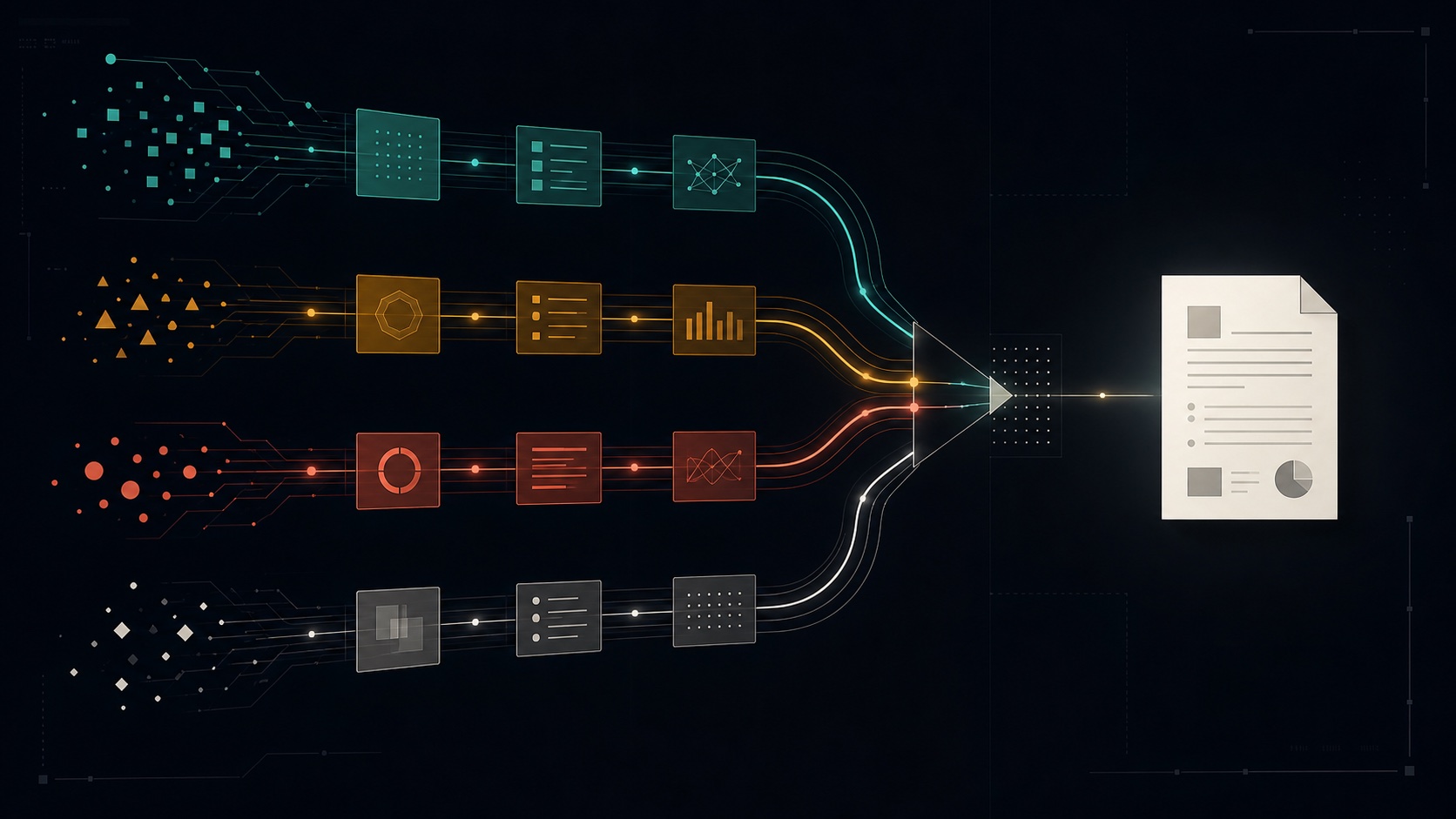
A new kind of reading session
Analysts, consultants, and team leads have always had to review large document sets under time pressure. A typical board pack runs to 80–120 pages. A sell-side information memorandum runs to 150. A procurement evaluation can span a dozen vendor responses plus supporting financials. The old workflow — skim, flag, re-read critical sections, synthesise mentally — has not changed in a generation.
Claude Opus 5 changes the calculus. This pattern is drawn from Anthropic's announcement of Claude Opus 5 (24 July 2026), which introduced a one-million-token context window alongside a new effort dial. At the max effort setting, Opus 5 is the current leader on AA-Briefcase, an agentic knowledge-work benchmark that evaluates models on tasks requiring research reports, presentations, and structured analysis across thousands of input files. Box, which integrated the model into its due diligence workflow, reported a 17% performance gain over its predecessor on that specific task type.
The implication for knowledge workers: a document set that previously required chunking across multiple sessions, or skimming in parallel with a colleague, can now be loaded into a single context and queried with precision. The skill is in the query.
What this is for
Use this brief when you have a bundle of related material that needs to become a view, a recommendation, or a decision. Common scenarios:
Board packs. Board papers, management accounts, committee minutes, and supporting appendices loaded together so the model can surface inconsistencies across the pack — not just summarise each paper in isolation.
Due diligence files. Information memoranda, audited accounts, customer contracts, and key-man schedules reviewed in a single pass with risk flagging and source citations.
Research compilations. Multiple analyst reports, expert call transcripts, or market studies synthesised into a unified view of what the evidence actually shows — and where it conflicts.
Procurement packs. Vendor proposals, pricing schedules, and reference responses scored against a shared set of criteria.
The brief does not replace judgment. It front-loads orientation so you know where to spend it.
Copy this brief
Why each element earns its keep
Context and My role. Without these two lines, Opus 5 defaults to a generic summary that could apply to any document set. "Context" focuses the model on what the pack is actually about; "My role" shapes the vocabulary and level of detail it uses. An analyst preparing an investment committee memo and a board member reading board papers need different outputs from the same source material.
Decision supported. This is the most important anchor. Risks that are irrelevant to the specific decision receive less weight; risks that are decision-critical get elevated. Without a stated decision, the model cannot prioritise — it flags everything equally.
TOP RISKS with source citations. Without the citation instruction, the model may assert risks confidently that are not in the documents — drawing instead on general knowledge about the sector or deal type. Demanding a specific document and section for each risk keeps the output tethered to what you actually uploaded.
OPEN QUESTIONS. This section is the most underused part of any AI document review. A model that has read the whole pack simultaneously can detect inconsistencies between documents that a human reviewer, reading sequentially, might miss: a forecast that conflicts with the audited accounts, a contract term that contradicts the management representation, an expert estimate that sits 40% above the consensus range. Ask for it explicitly.
RECOMMENDED FOCUS. The output tells you where to spend your own reading time. The model is faster at orientation; you are better at judgment. Dividing the labour this way is the point.
"Do not fill gaps with assumptions." Opus 5 is a strong reasoner, which means it will construct plausible inferences when evidence is absent — unless explicitly told not to. You want the document's evidence, not the model's extrapolation. This rule makes the absence of evidence visible rather than covered over.
Failure modes
Confident citations that do not exist. The model may cite a page number that is off by one, or attribute a claim to the wrong document. Spot-check three citations before relying on the output. If any fail, add to the prompt: "Only cite content you have read verbatim in the attached files. Do not infer or estimate page numbers."
The summary that replaces reading. The executive summary may be sufficiently polished that it discourages you from reading the source material at all. The OPEN QUESTIONS and RECOMMENDED FOCUS sections exist to pull you back to the pack. The model surfaces where to look; the reading is still yours.
Responses that are too long. If the output runs past 1,200 words, the model has drifted from the brief. Add: "Each section should be brief and scannable. Use plain language. No bullet sub-bullets."
Context limits on very large packs. The one-million-token window holds roughly 750,000 words — equivalent to approximately 3,000 pages of standard text. Most document packs fall comfortably within this. If the model signals it has reached a limit, upload the highest-priority documents first and run separate sessions for supporting material.
Missing confidentiality check. Before uploading any document pack, run it through your organisation's confidentiality gate. Client data, deal terms, and personal information may be subject to restrictions on third-party processing. This brief is a tool for permitted material only.